Does crypto still grow in a wallet?

A crypto wallet is the tool that gives you access to your digital assets. It shows your balance, lets you send and receive coins, and confirms that you are the person allowed to use them. Even though the word “wallet” sounds familiar, the mechanics are different from cash in a pocket or money in a bank account.
On this page
What is a crypto wallet
Your coins are not sitting inside the wallet app itself. They remain on the blockchain. The wallet manages the private keys or recovery credentials that give you control over those assets. Without that access, you cannot move funds, approve transactions, or prove ownership.
That is where a lot of early confusion starts. People see an app with a balance inside it and naturally assume the wallet is also the place where growth happens. The question “Does my crypto still grow in a wallet?” usually comes from that assumption. A wallet feels like a home for the asset, so it is easy to think the wallet must also play a role in increasing its value or amount.

In reality, the wallet’s role is much narrower. It is there to help you access funds, authorize transfers, and connect with other parts of the crypto ecosystem. Some wallets are simple and focus almost entirely on security and storage. Others add extra functions such as token swaps, staking access, NFT support, or connections to decentralized apps.
There are also different forms of wallets. Software wallets run on phones, laptops, or browsers. Hardware wallets keep credentials offline and appeal to users who care most about security. Custodial wallets are managed by a company, while non-custodial wallets put control directly in the hands of the user. That difference matters because convenience and responsibility do not always sit in the same place.
Once that basic structure is clear, the rest of the topic gets easier. A wallet is not a growth product by nature. It is an access tool. Whether your holdings go up, down, or stay flat depends on what the market is doing or on what you choose to do with the assets after storing them.
Do cryptocurrencies grow in a wallet?
Crypto can rise in value while it sits in a wallet, but that does not mean the wallet is generating that growth. That is the key point behind the question: does crypto still grow in a wallet.
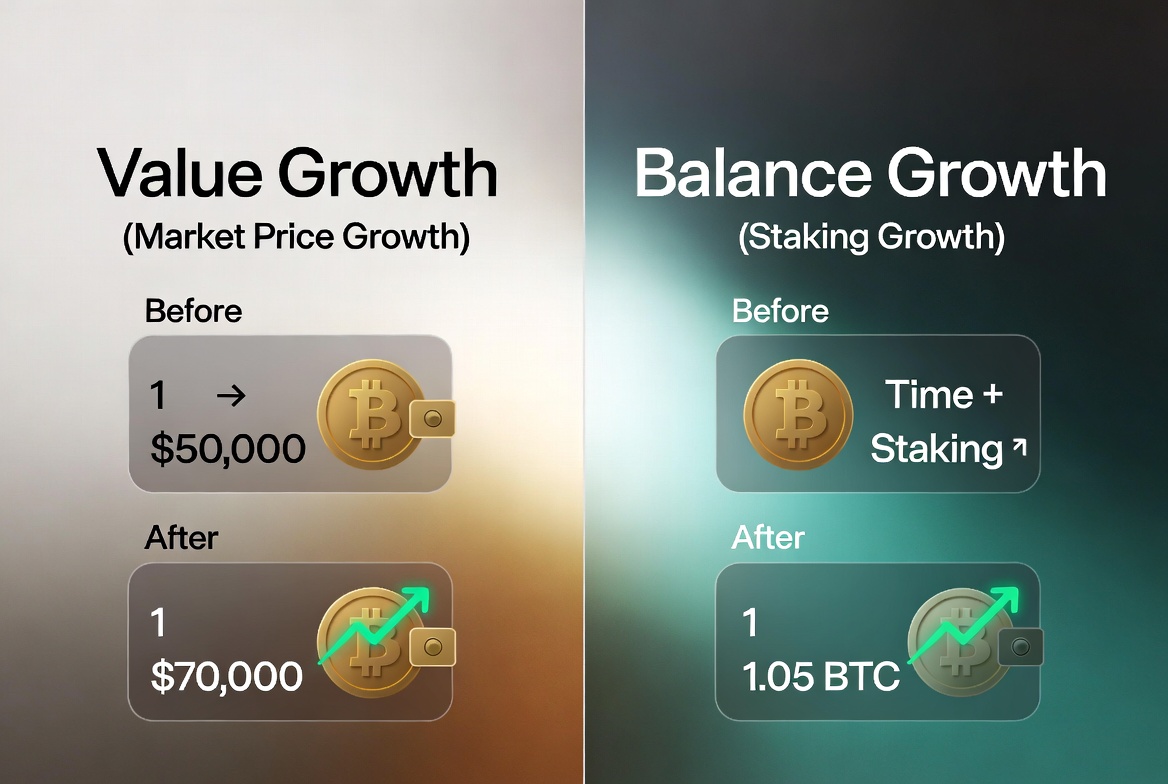
Take a simple example. You buy 2 ETH and leave them in your wallet for six months. During that time, the market price of ETH moves higher. Your wallet now shows a larger portfolio value in dollars or euros. Your holdings are worth more than before, yet the balance still reads 2 ETH. You have the same amount of crypto. What changed was the market price, not the wallet’s behavior.
This is why it helps to separate value growth from balance growth. Value growth happens when the asset becomes more expensive on the market. Balance growth happens when you actually receive more coins or tokens. Those are two very different outcomes, and they tend to get mixed together in everyday conversation.
A wallet does not create either one on its own. It reflects them. If the market rallies, the wallet shows the new price. If the market falls, the wallet shows that too. If you receive rewards from staking or some other program, the wallet updates the balance. In all cases, it is the display and control layer, not the source of the result.
That is also why comparisons with savings accounts can mislead beginners. People are used to the idea that storing money somewhere might produce interest just from sitting there. Standard crypto wallets do not work that way. Simply holding assets in a wallet does not cause more of those assets to appear over time.
So the honest answer is mixed. Yes, crypto can “grow” in a wallet if you mean the market value of the holdings can rise while they are stored there. No, crypto does not grow in a wallet if you mean the wallet itself is increasing your balance by default. Those two ideas sound close, but they lead to very different expectations.
How crypto can grow beyond simple storage
Anyone looking for ways to make their crypto grow usually has to move beyond plain storage. That means using systems that are built to pay rewards, distribute yield, or increase holdings through participation.
Staking is often the first route people explore. On Proof-of-Stake networks, users can lock or delegate assets to help support the network and receive rewards in return. Some wallets make this easy by placing the staking option right inside the interface. That convenience can make it look as though the wallet is producing growth, but the rewards are coming from the blockchain’s staking model rather than from the wallet itself.
Lending opens another path. A holder can supply assets to a platform, protocol, or borrower and earn a return for making that capital available. In that case, the balance may increase over time, but extra return comes with extra exposure. Counterparty risk, smart contract failures, liquidity problems, and platform collapses all become relevant once funds are used actively instead of being stored passively.
Reward-based programs can also increase balances. Some ecosystems distribute tokens to users who provide liquidity, participate in governance, use certain products, or keep funds within a particular network. These programs can look attractive, especially during periods of rapid market expansion, though not every reward model lasts. A larger token balance is only meaningful if the asset being paid out keeps real value.
Security becomes a much bigger issue once storage turns into activity. Approving the wrong contract, trusting a weak protocol, or connecting a wallet to a shady app can undo months of gains very quickly. That is why return figures on their own never tell the whole story. The method behind the return matters just as much as the number attached to it.
Some holders prefer to keep things simple and rely only on price appreciation. Others are comfortable taking on more complexity in exchange for the chance to increase their balance. Neither approach is automatically right or wrong. The better fit depends on risk tolerance, time horizon, and how much responsibility the user wants to take on.
Final verdict
A wallet gives you access to your crypto and helps protect control over it. That is its main job. Nothing about ordinary wallet storage automatically increases the number of coins or tokens you own.
So, does your crypto grow in a wallet? It can grow in value while it stays there, because the market price of the asset may rise. That part is real. What the wallet does not do on its own is generate extra balance just because time passes.
More coins or tokens usually appear only when the holder uses an additional feature such as staking, lending, or a reward-based program. At that point, the wallet becomes the entry point to a separate system that may produce returns, but it also brings new risks.
Put simply, a wallet is for access, storage, and control. Growth comes either from the market repricing the asset or from using tools connected to the wallet that are built to pay rewards. Once that line is clear, the question becomes much easier to answer without hype or false expectations.
Articles by this author