Seed phrase vs private key

Learn crypto private key vs seed phrase differences, how each controls wallet access, and which one matters most for recovery and security.
On this page
Managing crypto safely starts with understanding how wallet access works. Two terms appear often in this topic: seed phrase and private key. They are closely connected, and both can give control over crypto funds, but they are not the same thing. Knowing the difference helps users avoid mistakes, protect assets, and recover wallets correctly when needed.
Seed phrase vs private key
The phrase private key vs seed phrase compares two essential parts of crypto wallet security. A private key is a long cryptographic code that gives access to funds connected with a specific blockchain address. It is used by a wallet to authorize transactions and prove that the user has the right to move assets from that address.
A seed phrase, also called a recovery phrase or mnemonic phrase, is a group of words that can restore an entire crypto wallet. Most seed phrases contain 12, 18, or 24 words. These words are generated when a user creates a non-custodial wallet. The seed phrase acts as the master backup for the wallet because it can recreate the wallet’s private keys.
This means both a seed phrase and a private key can control funds. Anyone who has the correct private key can access and move crypto from the address linked to that key. Anyone who has the seed phrase can usually restore the whole wallet and access all addresses and assets generated from it.
The difference is in their role. A private key is more specific. It controls one address or account. A seed phrase is broader. It can generate many private keys and recover the complete wallet structure. In simple terms, the seed phrase is like the master key to the wallet, while a private key is like the key to one specific door inside that wallet.
This is why seed phrases must be protected with extreme care. If someone gets your seed phrase, they may not need your device, password, or wallet app. They can import the phrase into another compatible wallet and gain access to your funds. The same is true for a private key, but usually only for the address connected to that particular key.
How they compare: differences and similarities
When comparing crypto private key vs seed phrase, the most important difference is scope. A private key is tied to a specific blockchain address. It is used to sign transactions from that address. A seed phrase can recover the full wallet and regenerate multiple private keys, depending on how the wallet is built.
A private key is usually a long string of letters and numbers. It may look random and is not designed to be easy for humans to remember. A seed phrase is written as ordinary words, making it easier to record and back up. However, “easier to write down” does not mean safer by default. A seed phrase still needs strong offline protection because it can unlock the wallet.
The recovery function is another major difference. If you lose access to a wallet app or device, the seed phrase is usually what you use to restore the wallet. You install a compatible wallet, choose the recovery option, enter the seed phrase, and the wallet recreates the addresses and private keys.
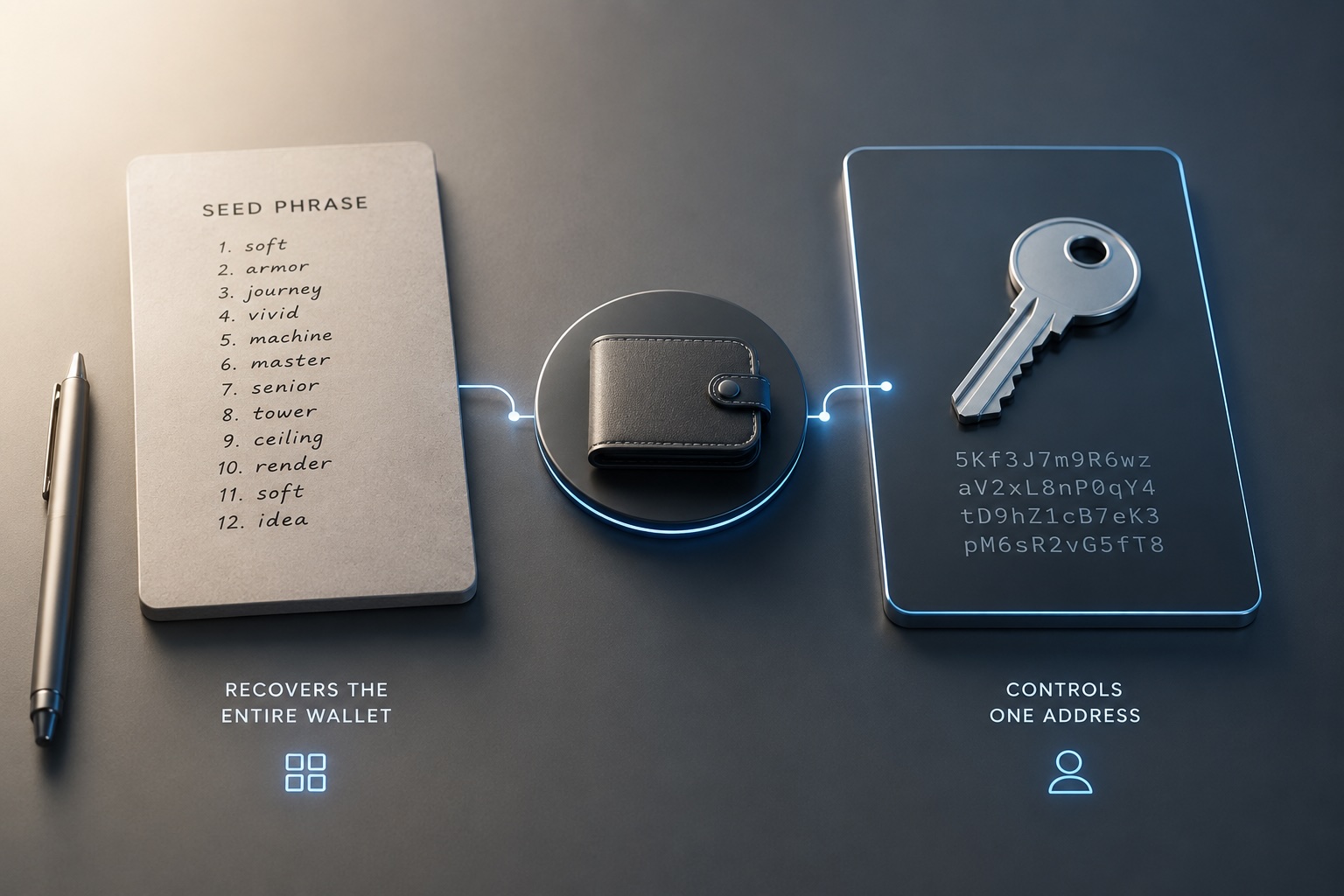
A private key can also be imported into some wallets, but it usually restores access only to the related address. This makes it useful in specific cases, such as moving funds from one address or accessing an old wallet address. Still, for most everyday users, the seed phrase is the main recovery tool.
They also have similarities. Both must remain private. Both can allow someone to move crypto without your permission. Both should never be shared through messages, screenshots, cloud notes, email, or customer support chats. Real wallet providers and exchanges should not ask for your seed phrase or private key.
Another similarity is that neither one can be easily changed like a password. If your email password is exposed, you can reset it. If your seed phrase or private key is exposed, the safest response is usually to move funds to a new wallet with a new seed phrase before an attacker does.
The structure is also important. A seed phrase follows a word-list standard used by many wallets, while private keys are cryptographic values used directly to authorize blockchain transactions. Users may interact with the seed phrase more often during setup and recovery, while the wallet software handles private keys in the background during normal use.
For example, when you send crypto, you do not usually type your private key manually. The wallet uses it internally to sign the transaction. When you restore a wallet on a new device, you usually enter the seed phrase, not each private key one by one.
Which option fits you best?
The question seed phrase vs private key is not really about choosing one and ignoring the other. In most modern wallets, users rely on a seed phrase because it is the main backup and recovery method. The private keys exist behind the scenes, and the wallet uses them when transactions need to be signed.
For most crypto users, the seed phrase is the most important item to protect. It fits people who want simple wallet recovery, long-term access, and control over multiple assets or addresses. If you use a non-custodial wallet, write down the seed phrase carefully, store it offline, and keep it away from cameras, cloud storage, and internet-connected notes.
A private key becomes more relevant for advanced wallet management. Users may need a private key when importing a specific address, managing older wallets, working with certain blockchain tools, or moving funds from one address without restoring a full wallet. However, handling private keys manually increases the chance of mistakes, especially for beginners.

For access, the seed phrase gives broader control. It can restore the wallet across compatible applications. For recovery, it is usually the primary backup. For control, it represents ownership of the wallet’s generated keys. Losing it can mean losing access forever if there is no other backup.
A private key gives direct control over one address. It is powerful but narrower. If you only have one private key, you may not be able to restore every address in the original wallet. You can control the assets linked to that key, but not necessarily the full wallet history or all accounts generated from the seed phrase.
The best approach is to understand both and protect both. Never share either one. Never enter them into unknown websites. Be careful with phishing pages that imitate wallet apps. Store backups offline, ideally in more than one secure physical location. For larger holdings, consider using a hardware wallet, which keeps private keys isolated from everyday internet-connected devices.
In daily crypto activity, you will probably see your seed phrase during wallet setup and recovery, while private keys stay hidden inside the wallet software. That is a good thing. The less often you expose sensitive wallet data, the lower the risk.
A seed phrase and a private key both matter because crypto ownership depends on cryptographic access, not account recovery through a bank or support team. The seed phrase is the master recovery backup. The private key is the transaction authorization key for a specific address. Understanding this difference helps you manage your wallet with more confidence and avoid losing control of your funds.
Articles by this author